JointReliveX's Ingredient Doses vs the Doses Used in Clinical Trials: A Label Comparison
Sourced from the product label and PubMed-indexed research · Updated 27 September 2026 · about a 12-minute read
The short version
JointReliveX prints eight ingredients with individual milligram amounts. Lined up against the doses used in published clinical trials, the picture is mixed: glucosamine (1,000mg) is in the same range as the largest trial (1,500mg), while chondroitin (100mg), turmeric root (100mg) and MSM (16.7mg) sit well below the amounts those ingredients were actually tested at. Boswellia (133.3mg) and quercetin (16.7mg) fall inside or below the ranges used in smaller trials, and methionine (16.7mg) and bromelain (16.7mg) have little or no ingredient-specific dose-response data to compare against at all. This article goes through each of the eight, one at a time, with the trial doses and their PubMed sources.
- Closest to trial dose: glucosamine sulfate (1,000mg vs 1,500mg studied).
- Furthest below trial dose: MSM (16.7mg vs 6,000mg studied in one trial).
- Different ingredient entirely: turmeric root (100mg) vs standardized curcumin extract (1,500mg studied).
Why dose matters more than the evidence-ranking question
A separate article on this site, Glucosamine, Chondroitin & Turmeric for Joint Pain, ranks these ingredients by how strong their overall evidence base is — curcumin and boswellia reasonably well-supported, glucosamine and chondroitin more mixed. That is a different question from the one this article asks. Here, the question for each ingredient is narrower and more mechanical: assuming the ingredient has some real effect at an effective dose, does the amount printed on the JointReliveX label match the amount that produced that effect in the trials? An ingredient can have decent evidence in general and still be underdosed in a specific product, and that gap is worth checking separately from the evidence-quality question.
1. Glucosamine sulfate: 1,000mg on the label
The largest and most frequently cited trial in this category is the Glucosamine/chondroitin Arthritis Intervention Trial (GAIT), a multicenter, placebo- and celecoxib-controlled study of 1,583 patients with symptomatic knee osteoarthritis. It tested 1,500mg of glucosamine daily, 1,200mg of chondroitin sulfate daily, the two combined, 200mg of celecoxib daily, or placebo, for 24 weeks (Clegg et al., 2006, New England Journal of Medicine, PMID 16495392). JointReliveX's 1,000mg of glucosamine sulfate is about two-thirds of that studied amount — the closest match to a trial dose of any ingredient on this label, though still meaningfully below it, not equal to it.
2. Chondroitin sulfate: 100mg on the label
In the same GAIT trial, the chondroitin sulfate dose was 1,200mg per day (Clegg et al., 2006, PMID 16495392). JointReliveX lists 100mg of chondroitin sulfate — about one-twelfth of the dose used in that trial. This is one of the largest gaps on the label in absolute proportional terms: even setting aside any debate about whether chondroitin works at all (the evidence, discussed in the companion evidence-ranking article, is genuinely mixed), 100mg is a small fraction of what was tested in the most widely cited study of this ingredient.
3. Turmeric root: 100mg on the label, and a form mismatch
Turmeric is where dose and form both diverge from the trial literature. In a multicenter, randomized, double-blind trial in 367 patients with knee osteoarthritis, standardized Curcuma domestica (turmeric) extract at 1,500mg per day was compared with ibuprofen 1,200mg per day over four weeks, and the extract performed non-inferiorly on pain and function scores, with fewer gastrointestinal side effects (Kuptniratsaikul et al., 2014, Clinical Interventions in Aging, PMID 24672232). JointReliveX's label states "Turmeric Root 100mg," not a standardized extract — a form distinction that matters as much as the dose gap. A standardized extract is concentrated specifically for curcuminoid content; plain root, milligram for milligram, delivers a small fraction of that. So the gap here is really two gaps stacked together: 100mg is 1/15th of the 1,500mg studied, and it is a less concentrated form of turmeric to begin with, meaning the effective curcuminoid gap is almost certainly larger than the raw milligram ratio suggests.
4. Boswellia extract: 133.3mg on the label
Boswellia trials show a wider range of doses than most other ingredients here, partly because "boswellia extract" covers products with very different standardization levels. In one 30-day trial in 60 knee osteoarthritis patients, a specialized, enriched boswellia extract (Aflapin®) dosed at 100mg per day produced significant improvements in pain and function scores within five days (Vishal, Mishra & Raychaudhuri, 2011, International Journal of Medical Sciences, PMID 22022214). A related 90-day trial comparing two enriched extracts, 5-Loxin® and Aflapin®, used the same 100mg daily dose for each (Sengupta et al., 2010, International Journal of Medical Sciences, PMID 21060724). An earlier, smaller crossover trial found benefit from an eight-week course of Boswellia serrata extract without stating a milligram dose in its published abstract (Kimmatkar et al., 2003, Phytomedicine, PMID 12622457). JointReliveX's 133.3mg is in the same rough range as the 100mg doses used in the enriched-extract trials — but those trials used extracts specially concentrated and standardized for boswellic-acid content (5-Loxin and Aflapin are both branded, standardized extracts), while the JointReliveX label states no boswellic-acid percentage at all. So the milligram figure alone looks reasonably comparable; without a standardization percentage, whether the active-compound dose is actually comparable cannot be confirmed from the label.
5. Quercetin: 16.7mg on the label
The two joint-specific trials that included quercetin used it only as part of a larger combination product, at doses higher than JointReliveX's. A 16-week trial in 40 knee osteoarthritis patients combined 45mg of quercetin glycosides with 1,200mg glucosamine and 60mg chondroitin (Kanzaki et al., 2012, Journal of the Science of Food and Agriculture, PMID 21969261), and a follow-up 100-person trial used 90mg of quercetin glycosides in a similar combination (Kanzaki et al., 2015, Clinical Interventions in Aging, PMID 26604721). JointReliveX's 16.7mg is roughly one-third to one-fifth of those combination-trial amounts, and, as covered in more depth in the companion article on this site's two smallest ingredients, no trial has tested 16.7mg of quercetin alone.
6. MSM: 16.7mg on the label
MSM shows the largest proportional gap on this entire label. In a 12-week, placebo-controlled pilot trial in 50 adults with knee osteoarthritis, MSM was dosed at 3 grams twice a day — 6,000mg total per day — and produced significant improvements in pain and physical-function scores compared with placebo (Kim et al., 2006, Osteoarthritis and Cartilage, PMID 16309928). JointReliveX's 16.7mg is roughly 1/360th of that studied amount. Even allowing for the fact that MSM trials generally use gram-level doses because MSM is a relatively low-potency compound per milligram compared to concentrated botanical extracts, this is the single largest dose disparity between a JointReliveX ingredient and its published trial dose.
7. Bromelain: 16.7mg on the label
Bromelain is harder to pin to a single comparison dose because it is almost always studied as part of multi-enzyme combination products rather than alone. In a six-week trial in 103 knee osteoarthritis patients, an oral enzyme-rutosid combination containing bromelain, trypsin and rutoside performed comparably to the NSAID diclofenac (Akhtar et al., 2004, Clinical Rheumatology, PMID 15278753), but the published abstract does not break out the bromelain-specific milligram dose used, and commercial multi-enzyme products of this kind are also typically standardized by enzymatic activity (GDU or MCU) rather than weight alone — a figure not printed on the JointReliveX label, as covered in the companion label-reading article. Because of that, 16.7mg of bromelain cannot be cleanly compared to a single trial dose; what can be said is that bromelain in the published literature is generally studied in combination products whose bromelain component and activity level are not straightforward to match against a bare 16.7mg weight figure.
8. Methionine: 16.7mg on the label
As detailed in the companion article on this site's two overlooked minor ingredients, this search did not find a published human trial testing oral methionine itself, at any dose, for a joint outcome. The related compound SAMe (S-adenosylmethionine), which the body synthesizes from methionine, has been tested for knee osteoarthritis at 1,200mg per day, performing comparably to celecoxib 200mg per day in one trial (Najm et al., 2004, BMC Musculoskeletal Disorders, PMID 15102339) — but SAMe is a different, downstream compound from methionine, dosed there at roughly 72 times the 16.7mg of methionine on this label, so that figure cannot be used as a stand-in dose comparison for methionine itself. There is, in short, no methionine-specific trial dose to compare this label amount against.
The comparison table
| Ingredient | JointReliveX label | Typical trial dose found | Gap |
|---|---|---|---|
| Glucosamine sulfate | 1,000mg | 1,500mg (GAIT, PMID 16495392) | About 2/3 of trial dose |
| Boswellia extract | 133.3mg | 100mg standardized extract (PMID 22022214, 21060724) | Similar weight; standardization unconfirmed |
| Chondroitin sulfate | 100mg | 1,200mg (GAIT, PMID 16495392) | About 1/12 of trial dose |
| Turmeric root | 100mg (plain root) | 1,500mg standardized extract (PMID 24672232) | 1/15 of trial dose, plus a form mismatch |
| Quercetin | 16.7mg | 45–90mg in combination trials (PMID 21969261, 26604721) | About 1/3 to 1/5 of trial dose |
| MSM | 16.7mg | 6,000mg (PMID 16309928) | About 1/360 of trial dose |
| Bromelain | 16.7mg | No single-ingredient dose isolated in trials found | Not directly comparable |
| Methionine | 16.7mg | No direct joint trial found (SAMe, a different compound, studied at 1,200mg) | Not directly comparable |
What to make of this pattern
Lining the eight ingredients up this way shows a consistent shape: the ingredient with the largest printed amount, glucosamine, is also the one closest to its trial dose, while several of the smaller-dose ingredients — chondroitin, turmeric, MSM, quercetin — are printed well below the amounts used in the trials cited for them, sometimes by an order of magnitude or more. That is a common pattern in the joint-supplement category generally, not something unique to this product: fitting eight active ingredients, each at a fully-dosed amount, into two capsules is a real formulation constraint, and manufacturers routinely trade dose size for ingredient count. It is also, independently, exactly the kind of gap a fact-checking source flagged about this specific product: a third-party review of JointReliveX noted that its chondroitin and quercetin doses looked substantially lower than the amounts used in the studies it cited — a caveat from that reviewer's own assessment, not an independently verified figure, but one that lines up with the trial-by-trial comparison above.
None of this means the ingredients are useless at these amounts, and it does not mean the product is unsafe — low doses of these particular compounds do not carry meaningful safety concerns at the levels printed here. What it does mean is that "contains glucosamine, chondroitin, turmeric, boswellia, MSM, quercetin, bromelain and methionine" is a different, weaker claim than "contains these ingredients at the doses shown to work in published trials." Reading the ingredient list without checking the milligram amounts against research doses risks assuming the stronger claim when only the weaker one is actually supported.
Frequently asked questions
Does JointReliveX use the same doses as clinical trials?
Partly. Glucosamine sulfate at 1,000mg is close to the 1,500mg used in the largest published trial. Several other ingredients are printed well below common trial doses: turmeric root at 100mg is far below the 1,500mg of standardized curcumin extract used in a head-to-head ibuprofen trial, chondroitin at 100mg is well under the 1,200mg used in the same major trial as glucosamine, and MSM at 16.7mg is roughly 1/360th of the 6,000mg per day tested in a knee osteoarthritis pilot trial.
Is JointReliveX's turmeric the same as the curcumin extracts used in trials?
No. JointReliveX lists "Turmeric Root" with no stated curcuminoid percentage, which is a different, much less concentrated ingredient than the standardized curcumin extracts (often 95% curcuminoids) used in most positive knee-osteoarthritis trials. A 100mg amount of plain root delivers a small fraction of the curcuminoid content that a 100mg amount of standardized extract would.
Which JointReliveX ingredient is closest to its typical trial dose?
Glucosamine sulfate. JointReliveX lists 1,000mg per serving, and the largest published trial (the GAIT trial) used 1,500mg per day, so the label amount is in the same order of magnitude, though still about two-thirds of that dose.
References
- Clegg DO, et al. Glucosamine, chondroitin sulfate, and the two in combination for painful knee osteoarthritis. N Engl J Med. 2006. PMID 16495392
- Kuptniratsaikul V, et al. Efficacy and safety of Curcuma domestica extracts compared with ibuprofen in knee osteoarthritis. Clin Interv Aging. 2014. PMID 24672232
- Vishal AA, Mishra A, Raychaudhuri SP. Early efficacy of aflapin in osteoarthritis of the knee. Int J Med Sci. 2011. PMID 22022214
- Sengupta K, et al. Comparative efficacy of 5-Loxin and Aflapin against osteoarthritis of the knee. Int J Med Sci. 2010. PMID 21060724
- Kimmatkar N, et al. Efficacy and tolerability of Boswellia serrata extract in osteoarthritis of knee. Phytomedicine. 2003. PMID 12622457
- Kim LS, et al. Efficacy of methylsulfonylmethane (MSM) in osteoarthritis pain of the knee. Osteoarthritis Cartilage. 2006. PMID 16309928
- Kanzaki N, et al. Effect of glucosamine, chondroitin sulfate and quercetin glycosides on knee osteoarthritis. J Sci Food Agric. 2012. PMID 21969261
- Kanzaki N, et al. Glucosamine-containing supplement improves locomotor functions in subjects with knee pain. Clin Interv Aging. 2015. PMID 26604721
- Akhtar NM, et al. Oral enzyme combination versus diclofenac in osteoarthritis of the knee. Clin Rheumatol. 2004. PMID 15278753
- Najm WI, et al. SAMe versus celecoxib for osteoarthritis symptoms. BMC Musculoskelet Disord. 2004. PMID 15102339
Related reading
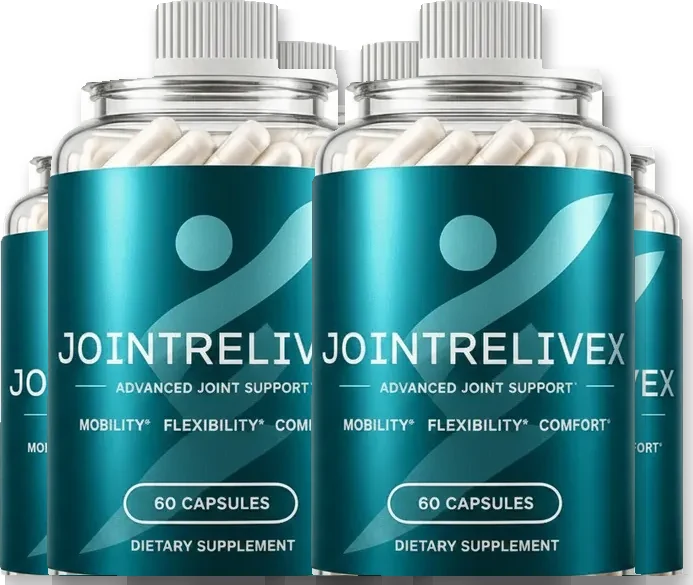
See the full JointReliveX ingredient breakdown
Every printed amount, the current pricing tiers and the 60-day guarantee — in one place.
Order JointReliveX